The U.S. Embassy in Vienna recently observed Austrian-American Day, launching a series of events. This celebration underscored the profound historical and current ties between Austria and the United States. Furthermore, it showcased the significant impact of these connections across various sectors.
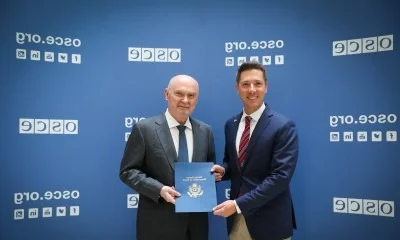
U.S. Ambassador Art Fisher initiated the festivities with a special reception. He hosted graduates from leading U.S. universities who now reside in Austria. This networking event brought together influential figures from politics, business, academia, and civil society. Ambassador Fisher emphasized that strong interpersonal relationships form the very heart of this bilateral partnership.
The reception clearly highlighted the importance of direct people-to-people connections. The network of U.S. alumni in Austria includes graduates from prestigious institutions like Harvard, Stanford, and Columbia. Moreover, many recipients of the renowned Fulbright Program attended, which has fostered academic dialogue for decades. Groups like the Harvard Club of Austria and the Columbia Alumni Association of Austria represented their members actively. Fulbright Austria also continues its decades-long support for academic and cultural exchange.
This year’s Austrian-American Day also honored three Austrian-born pioneers. Their inventions and discoveries made world history in the United States. For example, Hedy Lamarr, a Vienna native, fled the Nazi regime in 1937. She became a Hollywood star and, as a self-taught engineer, co-developed the frequency-hopping technique. This 1942 patent now underpins modern communication like Wi-Fi, Bluetooth, and GPS.
Another celebrated figure was Walter Kohn, a Viennese physicist. He escaped to England via Kindertransport in 1938 and later earned his doctorate at Harvard. In 1998, Kohn received the Nobel Prize in Chemistry for his revolutionary density functional theory. Similarly, Eric Kandel, a Viennese neuroscientist, experienced Kristallnacht and emigrated to New York in 1939. His research at Columbia University on memory processes earned him the Nobel Prize in Physiology or Medicine in 2000.
Beyond science, Austrian culture profoundly shapes everyday life in the U.S. The embassy highlighted world-renowned exports such as Arnold Schwarzenegger, an iconic figure in American cinema. Celebrity chef Wolfgang Puck likewise revolutionized the U.S. restaurant industry. Meanwhile, the global success of Red Bull continues, while classic Austrian rye bread, partly inspired by bakeries like Martin Auer, gains popularity across the U.S. market.
Ambassador Fisher also attended a motorsports spectacle. He experienced the Austrian MotoGP Grand Prix at the Red Bull Ring in Spielberg. Before over 90,000 fans, the iconic U.S. brand Harley-Davidson took center stage. The ambassador proudly waved the checkered flag at the FIM Harley-Davidson Bagger World Cup finale. This event, tagged with #Freedom250, vividly demonstrated how traditional American products thrive at top-tier international motorsports events on Austrian soil.
Austrian-American Day originated from a 1997 proclamation by U.S. President Bill Clinton. It is celebrated annually on September 26. This date commemorates the significant historical contributions of Austrian immigrants to the development of the United States. Ultimately, the embassy’s broad celebration reinforces the enduring friendship between both nations.