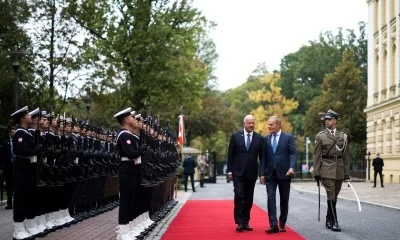
Austrian Chancellor Christian Stocker recently concluded a landmark visit to Warsaw. This trip marked the first time an Austrian chancellor traveled to the Polish capital in nearly two decades. Therefore, the visit underscored a renewed focus on Austria Poland relations.
Talks with Polish Prime Minister Donald Tusk largely centered on European security. Russia’s ongoing war in Ukraine was a primary concern. Prime Minister Tusk referenced the historic September 17, 1939, Red Army attack on Poland, highlighting the need to learn from history.
Tusk also revealed a recent massive Russian attack near the Polish border. This incident had prompted Polish fighter jets to go on alert just prior to their meeting. Chancellor Stocker affirmed Austria’s full solidarity with its neighbor.
He stressed that Russian attempts to destabilize EU members must fail. Even as a militarily neutral state, Austria vowed to contribute to European resilience. This commitment reinforces broader EU security efforts.
The two leaders agreed to significantly enhance economic ties. A bilateral economic conference will now convene every two years. This forum will be chaired by their respective economy ministers.
Austria announced a major infrastructure project. The nation plans to invest approximately €1 billion in the Nordbahn expansion. This substantial investment aims to halve the Vienna-Warsaw train journey from eight to four hours.
Poland’s economy is among Europe’s fastest-growing. Chancellor Stocker brought a high-level business delegation to capitalize on these opportunities. For example, Erste Group CEO Peter Bosek joined the trip, touring Erste Bank Polska headquarters.
Migration policy also featured prominently in discussions. Both Stocker and Tusk called for a unified EU approach. Stocker emphasized that external border protection is a shared European responsibility.
Poland plays a crucial role as a border state and host to Frontex, the EU’s border agency. Moreover, the leaders advocated for strict return policies for those without legal residency. Austria supports establishing return centers and asylum procedures in third countries.
Stocker also backed temporarily suspending asylum applications during exceptional border crises, citing examples like Ceuta. Tusk, meanwhile, highlighted Poland’s “Eastern Shield” (Tarcza Wschód) border fortification project. He stated this initiative safeguards the entire continent.
Regarding the EU economic framework, Chancellor Stocker urged reforms. He argued for reducing bureaucracy and ensuring affordable energy to boost competitiveness. Stocker criticized the dysfunctional merit-order system in the electricity market.
Tusk noted Austria’s status as a net contributor and Poland’s historical role as a major recipient of EU funds. However, he stressed that single market and border security investments benefit all members. Stocker reiterated security must be a budget priority. These discussions further strengthened Austria Poland relations.
Finally, the Austrian Chancellor extended an invitation to Prime Minister Tusk. He asked his Polish counterpart to make an official return visit to Vienna.